
Fields in Leavenworth County Property Tax Records
The Appraiser establishes market or appraised value as of January 1 and applies the Kansas class rate to reach assessed value. The Treasurer collects real estate tax and records the bill and payment layer. Read both sources for the same parcel and year.
| Field | What It Shows | Where |
|---|---|---|
| Land, building and total value | Dated appraisal components | Appraiser card |
| Assessed value | Appraised value after the class rate | Assessment roll |
| Classification and tax unit | Use class and taxing context | Appraiser card |
| Tax bill and status | Billed, paid, balance or delinquency | Treasurer search |
| Special assessments | Separate certified charges | Treasurer and County Clerk |
Revaluation happens every year, with inspection or remeasurement on a six-year cycle. A recorded sale amount is a deed fact. It lives in the deed records. That file is separate from the tax roll. Neither the assessed figure nor the bill promises what a property would bring at market.
Kansas Rates Behind Leavenworth County Assessments
Class rates drive everything. Residential real property is assessed at 11.5 percent of appraised value, while Kansas uses 12 percent for vacant lots and nonprofit property. Commercial and industrial real estate carries 25 percent, agricultural land and other property 30 percent, and public utility real property 33 percent. Get the classification right before applying any mill levy.
Appraised value: the county's market-value estimate. Assessed value: appraised value multiplied by the class rate. Mill levy: the rate applied to assessed value. Tax lien: a claim tied to unpaid tax.
Check the classification on the current parcel card. Don't assume the residential rate fits every tract. Agricultural, vacant, and commercial parcels each follow their own ratio.
Land, Building and Total Value on the County Card
The Leavenworth County Appraiser parcel search shows land, building, and total value for a stated year. Prior-year and tax-information links appear where available. It also lists the owner of record name, mailing address, situs, classification, neighborhood, and tax-unit context for each parcel. The county cautions that appraised information carries no warranty and that tax figures may reflect a prior assessed value. The tax description can differ from the Register of Deeds legal description too. Keep the parcel number handy. Compare both when an account looks unclear.
Open the Leavenworth County Tax Portal
The Treasurer links the official current and prior-year real-estate tax search shown below.
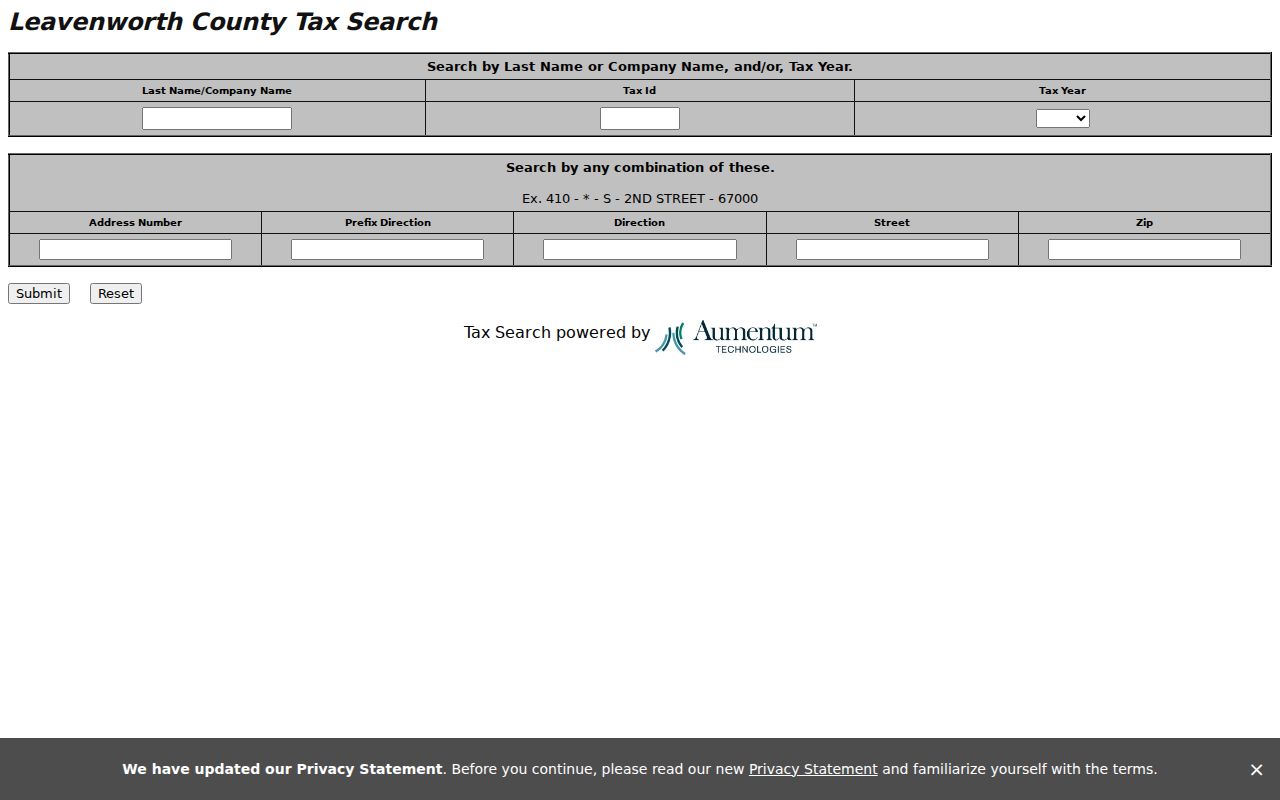
The county tax portal is the official entry point for the Treasurer's side of the ledger. Search-field labels on the live interface can change, so read the current screen before treating any one control as required.
Look Up a Leavenworth County Tax Bill
Keep the parcel and tax year fixed from start to finish. Start with the physical address and confirm the county parcel number on the appraisal card. Then open the Treasurer's tax search. If an address comes up empty, turn to the GIS map to retrieve the parcel. A ZIP code is not a property boundary.
- Locate the parcel by situs address and verify PID, owner label and value year.
- Open the tax-information link or Treasurer account search.
- Match the account to the same parcel and legal description.
- Read billed, paid, balance and special-assessment fields for the chosen year.
- Contact the Treasurer when a payment or official statement is not clear online.
- Assessment year
- The year attached to the county value.
- Tax year
- The billing period shown by the Treasurer.
- Special assessment
- A separately certified parcel charge.
- Delinquency
- Unpaid status that may later enter foreclosure.
December and May Dates Require a Live Check
Two deadlines matter here. The county Treasurer page states first-half tax is due December 20 and second-half tax May 11. Both dates avoid penalty and interest. The Kansas Department of Revenue calendar gives December 20 for the first half. But it lists May 10 for the second. Since the official pages disagree, trust the date printed on the current statement. Verify with the Treasurer.
Note: A due-date discrepancy is a reason to confirm the live bill, not to select whichever published date offers more time.
Leavenworth County Delinquency and Tax Sale
The delinquent prior-year list published in August is not the later tax-lien foreclosure auction list. An unpaid balance is neither an appraisal nor a promise of a current sale. Legal descriptions control. Owners may redeem before the sale. Confirmation in District Court comes before a Sheriff's deed is recorded.
The 2026 cycle listed a June 15 auction and a June 14 registration deadline. Those dates shift from cycle to cycle. Use the current county tax-sale page. Confirm restrictions, payment rules, redemption issues, and parcel status for the active cycle.
Property-Tax Relief Records and Applications
The Appraiser points property owners to Homestead, SAFESR, and Golden Years property-tax relief material. Eligibility and filing rules change. The benefit may run through a claim rather than a line simply labeled exemption. Read the current program form. Don't infer eligibility from age or an old account.
For a parcel error, gather the value notice, the parcel card, photographs, and any condition or sale evidence that supports your case. For relief, use the current state or county application. Ask the office named on that form how the claim appears in property tax records.
Tax Unit, Levy and Special-Assessment Context
An Appraiser card carries more than value figures. Tax unit, neighborhood and property-class codes sit alongside the appraisal. Treat them as taxing context, not proof of zoning or ownership. The county's GIS map adds another layer. It exposes tax districts, city limits and political boundaries that explain why neighboring parcels see different levies or notices.
Special assessments run through the County Clerk. The office also handles tax-roll and abstract work. It records real-estate ownership transfers for the assessment roll. A strange charge on a statement is not automatically bad data. Find its label on the statement. Then ask the Clerk or Treasurer which certification created it. Guessing from the dollar total invites errors.
The Treasurer is not an online-only operation. Besides the courthouse office, the office runs a Tonganoxie annex. So a parcel owner can call or visit with bill and payment questions. Appraisal facts stay with the Appraiser. Bring the account or PID and the tax year. Staff can then pull one record quickly.
Kansas Ratio Studies Versus One Parcel
Kansas tests its appraisal system from the top. The Department of Revenue publishes ratio-study statistics that measure appraisal level and uniformity across counties. Those numbers give useful context for Leavenworth County property tax records. They cannot judge one parcel, and they never prove a single value right or wrong.
Ground any argument in the parcel itself. Use its January 1 valuation facts, class and condition. Cite a ratio study only for the countywide measure and its stated year. Keep aggregate statistics apart from the parcel card. That separation prevents a system-level quality check from becoming a house-specific estimate.
Challenge a Leavenworth County Assessment
Kansas splits the protest process in two. Spring equalization appeals come first. Payment under protest is separate. The state property-tax calendar spells out the March notices, a 30-day equalization filing window measured from the notice, county meetings and possible Board of Tax Appeals review. Always work from the parcel's own dated notice.
Pin down the dispute before building a case. Is it property facts, classification, appraised value, assessed value, a levy or a special charge? Evidence should speak to that single issue. Keep sources and dates clear.
Appeal window. The ordinary equalization route is due within 30 days of the notice; payment under protest is a different path with its own timing.
Keep Tax and Title Separate
A paid tax account is not clear title. In Leavenworth County, the owner of record on a tax card can lag behind a newly recorded deed. Each record answers a different question. The Treasurer's account shows billed amounts, installments, payment status and delinquency. The Appraiser card carries the dated value and classification. The Register's newest conveyance names the grantee and the recorded legal description.
Splits and combinations make this check matter more. A new PID deserves the same three-way look. If the tax description and deed description differ, keep both and ask the responsible office to explain the record rather than quietly assuming one is wrong.